Six key questions about investor roadshows

Despite technology and regulation changes, face to face meetings remain the lynchpin of all IR activity, but they do require time and effort. Whilst the disclosure is regulated and obviously no non-public information will be provided, people also look for non-verbal cues and there is a lot to be said for “the whites of their eyes” test. The meeting is here to stay, so how do you maximise the returns?

Who should organise it?

There are three options: in-house, brokers or service providers. Each has pros and cons in terms of time, cost and reach (and the implications of Mifid II have been discussed at length elsewhere, so are not the focus of this article). In practice, a combination is likely to be most efficient and effective. If you go external, a good IRO will be able to question and challenge the organiser regarding new cities or regions and investors.

How do we target investors?

There are two basic approaches: quantitative and qualitative, both trying to identify those who are interested in your stock.

Qualitative approaches rely on the providers experience and knowledge as they are familiar with the sector, with your peers and your region. Roadshows around the full year/ half year results are usually organised by the “house brokers” but using other brokers can extend the pool of contacts. I always suggest doing some “beauty parades” getting brokers/ service providers to pitch for roadshows, and separately by region.

Quantitative tools exist which allow you to drill into theoretical investor appetite. These outputs are useful to overlay with the qualitative targeting work providing ideas, data and challenges which can be then be considered to generate a rigorous targeting.

Should we meet hedge funds?

I can’t believe how often this still comes up. I have always advocated not to exclude hedge funds. It should also be noted that some hedge funds actually limit shorting activities to currencies and indexes rather than on individual stocks, plus some large traditional “long-only” investors run short books, so a blanket rule wouldn’t work anyway.

Hedge funds run a lot of money and account for a large portion of daily trading. In addition, they are often very interesting meetings. Ignoring them isn’t going to make the risk of shorting go away. It’s far better to tackle the discussion head on – a meeting with an aggressive hedge fund known to be shorting the stock could actually have a positive impact in the market chatter, and a positive meeting with that hedge fund could result in the closing a short position which is just as as valuable as increasing a long-only investor’s position.

Who should present?

Investors often default to CEO/ CFO, for obvious reasons, but divisional management meetings can allow the investor to explore particular areas in more depth and free up CEO/ CFO diaries. An additional side-benefits are that it allows the divisional management team to gain skills which are often part of their own personal development objectives, plus it provides the market with comfort regarding the strength and depth of the management team.

IR only meetings are also very effective, and not just with new/ small investors. A strong IRO will be in a position to run hundreds of meetings a year to supplement the senior management team investor programme, freeing up their time whilst still providing high quality investor engagement activity.

Roadshows vs. conferences?

A dedicated roadshow is inevitably more detailed and targeted: the investors participating in it want to hear specifically about your company and are potentially more likely to be considering buying than a mixed bag of conference attendees.

But conferences are a very efficient way to see a large number of investors in one place. A series of back-to-back group meetings over a day could easily encompass over 50 investors, but with the investors rushing from one meeting to another the typical 35-minute ‘speed date’ can only provide highlights. Whilst this sounds negative, the “speed-dating” group meeting is a great way to introduce your story to potential new investors as well as to do quick catch ups with existing investors.

There is no right or wrong answer here. In the end, the key question is: What is the most productive use of time? Probably a mix of both, depending on the details of the conference. You can also do a hybrid – for example if you are attending an overseas conference, you can easily tag a roadshow onto it.

Group meetings vs. 121s?

This has an easy answer – both! Setting aside the volume/ time impact, they are very different and appeal to different investors for various reasons. Some large investors love attending groups so they can hear what others are thinking about, some potential investors want to sit in a group to get a general “feel” for a story before investing time in doing detailed research. You have tooter both in every programme to accommodate demand and interest.


Overall, the face-to-face IR meeting is a valuable and integral part of every successful IR programme. If you’d like an independent assessment of the effectiveness of your IR programme, I offer free initial “temperature check” to assess the current position and potential.


Best Practice In IR – Developing a Winning IR Toolkit

It won’t be a surprise to anyone to learn that investor relations affects the valuation of a company. A survey by Rivel Research showed

– 75% of buy-side believe good IR affects valuation, and

– poor IR can result in up to a 20% discount.

Here are some tips for your IR team to consider to get you off to a strong start:-

  1. Curate the available information carefully. With more and more data being available to investors, curating it effectively can greatly aid the investment decision. Layering information so that it’s easy for the investors to access, regardless of whether the investor wants to spend only 5 minutes (to get the key information quickly) or a couple of hours (without getting lost any rabbit holes).
  2. Know what you are. Articulate your message clearly so that no investor can be in any doubt as to the investment case is.
  3. Be real and accessible. In most cases, the investment process still starts with a personal contact. If they haven’t met your IR team and/ or management, there is a strong probability that you aren’t even on the fund manager’s radar.

What about the toolkit? There is nothing particularly complicated required to create an effective IR toolkit:-

  • yourself, your phone and your voice
  • company website, but you can supplement this with social media, working with your communications/ PR colleagues
  • quantitative and qualitative investor targeting work
  • technology will make your life easier, from CRM systems tailored to help IR, to free scheduling and project management apps. Even simple things like pre-designed meeting note templates will improve efficiency.

This year brings the 20th IR Society annual Best Practice in IR awards. As you set the team goals for 2020, why not consider entering? There are self entry categories which are judged by a panel, as well as voted awards. In addition to the honour and glory for winners, entrants generally see far wider benefits including internal recognition and it’s a great way to focus the team on what works and, importantly, what could potentially be improved.

Good luck!


Seven useful sites and blogs for IROs

If you’ve caught up on emails, scrolled through social media, and read the free newspaper on the bus/ train/ tube, here are seven sites you could browse (after this one, of course) before you play games on your phone.

1. https://www.irmagazine.com

This is US focussed but the themes and topics are equally relevant for UK based IR professionals. They also have great alerts you can sign up for.

2. http://www.irs.org.uk

This is the industry body in UK and has an invaluable depth of knowledge and content. Some of it is restricted to members only, but there are loads of articles and webinars that are open to all.

3. http://blog.investorrelations.com/blog

Slightly masquerading as a US professional body, this is a well-established advisory firm blog (Sharon Merrill Associates) has great general content.

4. https://www.phoenix-ir.com/blog/

This US investor relations advisory firm blogs regularly with great technical content.


Beyond the four IR specific content sites, the following sites should be on your desktop icons/ bookmarks bar or whatever system you use for speedy access.

5. http://m.londonstockexchange.com/exchange/mobile/rns/search.html

RNS stands for “regulatory news service”. This newsfeed gives a live stream of announcements. It’s very useful for double/ triple checking your own announcements are public if you don’t have a Bloomberg/ Reuter’s screen on your desk.

6 http://www.reuters.com/finance/deals/mergers And http://uk.reuters.com/business/deals/ipos

Maybe not relevant to all IROs but there is great information on deals and IPOs.

7. https://www.sharecast.com/uk_shares/director_dealings

Maybe not relevant to the day-to-day IR tasks, but many investors track director trading activity so this is a useful compilation site to be aware of.


Hopefully you’ll find some interesting content. Don’t miss your bus stop!

Five books that should be compulsory reading for IROs

Last week I gave some non-technical book recommendations (a surprising number of which are also movies). This time, I’ve got some technical books to suggest which I reckon should be compulsory reading if you’re working in (or with) investor relations. Sorry – no movie options this time!

1. The Activist Director by Ira Millstein

This is a very detailed book written from a wealth of experience. The author is a corporate lawyer so it’s as dry as you might fear, but persevere! The governance points are spot on.

The activist director book cover


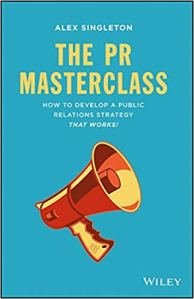
2. The PR Masterclass by Alex Singleton

Written by a former journalist who is now a communications and PR trainer and consultant, this is a clear, common-sense guide. Whilst the Activist Director is (admittedly) a dry read, this is easy, and will help any IR professional understand what their PR colleagues are working on.

The PR Masterclass book cover


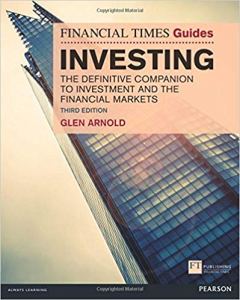
3. The Financial Times Guide to Investing:The Definitive Companion to Investment and the Financial Markets

Despite the ridiculously long title (presumably to catch every single keyword in the Amazon algorithm), this book stands the test of time and is still probably the most comprehensive book on investing.

FT Guide to Investing book cover


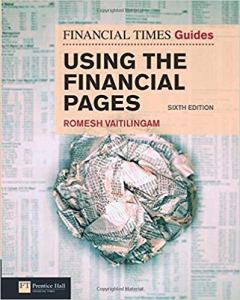
4. The Financial Times Guide to Using the Financial Pages

I don’t understand why this book isn’t higher ranked. Probably because it fails to cram 27 keywords into the title. Anyway, I think it’s brilliant and my own copy is well-read.

FT Guide to Using the Financial Pages book cover


5. Best practices for equity research analysts by James Valentine

Written by a top ranked equity analyst who worked in most of the big houses on Wall Street. Unlike the Wall Street characters whose heady lifestyles have been made into the book and movies I spotlighted last week, this is the grafter taking pride in the rigorous of analysis done at their desk. Valuations, price targets and recommendations. It’s less headline grabbing for sure, but essential reading.

Best Practices for Equity Research Analysts book cover

These will take a lot longer to read that the ones I included last week, but they are reference books that will be referred to over and over again during any career in financial markets.

Happy reading!

The easiest way to understand the City/ Wall Street

I’m often asked what books anyone working in, or looking to work in, investor relations should read. Obviously there are plenty books on finance, strategy, communications, presentations etc etc, but for fun, I usually suggest the person has a look at some of these too.

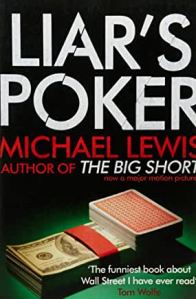
1. Liar’s Poker by Michael Lewis

Originally published in 1989, this was the first book about the markets I read when I started in IR and it’s still the best place to start if you’re interested in understanding Wall Street. This book made the (ghastly) phrase “big swinging dick” mainstream.
Liars Poker book cover

2. The Big Short by Michael Lewis

Michael Lewis is a prolific writer, which leads me to the second book. You can cheat on this one and just watch the movie if you prefer.

The Big Short book cover

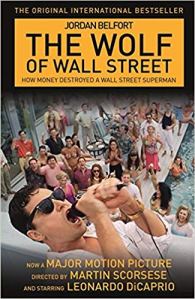
3. The Wolf of Wall Street by Jordan Belfort

Feel free to read any of Michael Lewis’s books, but for a variety, here’s another “character”. Again, you can opt for the movie version. A more grubby account than Liar’s Poker and soooo hard to put down!

Wolf of Wall Street book cover

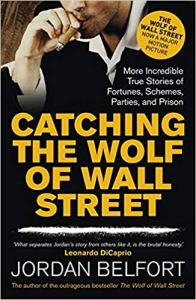
4. Catching the Wolf of Wall Street

If you’ve read (or watched) The Wolf of Wall Street, you’re probably dying to know what happens next.  Go on, you know you want to!

Catching the Wolf of Wall Street

5. Barbarians at the gate by Bryan Burrough

Another classic first published in 1989, this time looking at the battle for control of corporate giant RJR Nabisco. Written by a Wall Street Journal reporter, it brings a different perspective. It was made into a TV movie in 1993, but it’s a bit dated to watch now so I’m going to encourage the book.

Barbarians at the Gate

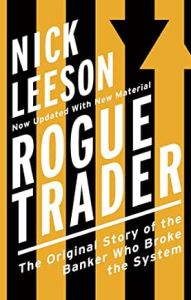
6. Rogue Trader by Nick Leeson

Personally blamed for the failure of Barings Bank in 1995, Nick Leeson’s name was splattered all over the UK media. It does take the “it wasn’t my fault” line (Bart Simpson?), but that’s understandable. Oh, and of course, there’s a movie. So much for the reading list!

Rogue Trader book cover

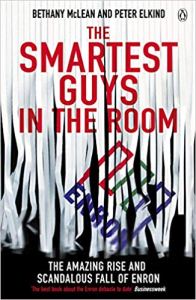
8. The smartest guys in the room by Bethany McLean and Peter Elkind

In 2001, the financial markets reeled from the tangled mess that was Enron which resulted in Sarbanes-Oxley Act.

The Smartest Guys in the Room book cover

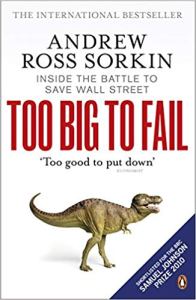
9. Too big to fail by Andrew Ross Sorkin

Bringing us up to date, the last few books cover the financial crisis.

Too big to fail book cover

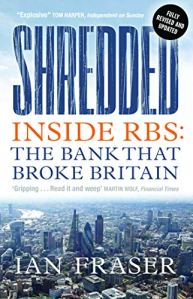
10. Shredded: Inside RBS, the bank that broke Britain by Ian Fraser

This is a clever title from his nickname “Fred the Shred” and the resultant RBS-specific verb “to be shredded”. Now, I worked for RBS for over a decade, so I’m not going to comment on the book – you’ll just have to read it and draw your own conclusions. The author is a financial journalist and has written for all the big publications.

Shredded


11. Making it happen : Fred Goodwin, RBS and the men who blew up the British economy by Iain Martin

Another journalist, and again, I’m going to leave it to the reader to decide!
Making it happen book cover
Happy reading! Let me know what you think of them. What would you add to the list?