RIP to the annual Investor Day

The Investor Day has been a fixed part of every IR calendar for decades. But is it time to call a day on the all singing, all dancing, annual Powerpoint extravaganza?

If you read my last blog, you’ll know I’m a big fan of the virtual roadshow. But that doesn’t mean I’m going to recommend we take the Investor Day online. If you ever had any doubt, lock-down has proved it’s completely impossible to concentrate on a webcast for that length of time.

In fact, over the years, physical attendee numbers at the official Investor Day events have generally declined, with more people opting to join online, dotting in and out, keeping half an eye on it whilst multi-tasking at their desks. Even before Covid, it was already starting to feel like the format needed to be refreshed. So what do you replace them with?

Easy: Workshops!

As well as the obvious benefits from removing capacity and location constraints, there are so many reasons why these are the way to build deeper investor and analyst engagement, and increase the understanding of your business.

If you’ve never hosted workshops, here are some things to consider.

  1. Keep the sessions bite-sized. They don’t need to be an hour, 45 minutes could be plenty. Maybe even 30 minutes? I love that Zoom frees us from the feeling of having to fill an hour to justify the meeting.
  2. Do a series, spotlighting a different aspect of your business in each session. Bonus – this is a great way to keep a steady flow of news and engagement with the capital markets participants. And, once you’ve done a few, you’ll be able to rattle through the prep in no time at all (well, a lot less time than for an Investor Day anyway).
  3. Consider doing something different – virtual creates the opportunity to do live product demos and site visits.
  4. Use the sessions as an opportunity to demonstrate the strength and depth of your leadership team, beyond the CEO and CFO who are more usually visible to the investor community.
  5. Host them jointly with your comms colleagues and invite the media too. Half the work for the IR team, double the benefit for the company. Win, win!

If you’d like to discuss your IR engagement and plans, why not book a “Power Hour” with me?

Six reasons to LOVE a virtual roadshow

As we come to the end of interim reporting season, most of us have now completed at least one fully virtual roadshow. Initial complaints about going virtual were that it is harder to establish a connection and that it isn’t as good as an ‘in-person’, ‘whites-of-the-eyes’ meeting. Then we grumbled about ‘Zoom fatigue’ and the tech issues of hopping from platform to platform. But we HAVE got used to it.

I guess it’s like the transition from letters to emails, and I’m old enough to recall the typing pool at the accountancy firm I trained at, complete with mountains of pink copies and yellow copies that, as a junior, I had to carefully file. Probably my best ever intern role was when a group of us were tasked with sorting the archives in the attic  – we discovered some sun loungers stashed up there and spent hours relaxing on the roof whilst theoretically deep archiving records. Not sure it added much to my personal development, but they did offer us all a training contract at the end of the summer!

So, I’m going to stick my neck out and say I hope the virtual roadshow is here to stay. Maybe supplemented by a traditional roadshow, but I believe virtual can be the primary format. I know some management teams, corporate brokers, and IRO’s, believe there are certain times that it is still better to do meetings in person (e.g. during a transaction), but I would challenge that it’s not necessarily better, just more familiar. Of course, it’s likely that we will end up with a hybrid model, but in defence of the virtual meeting, here are six killer benefits.

1.Time efficiency

Not only do you recoup the travel time between cities and in the car between meetings, but in a traditional meeting, there is almost an unspoken obligation to fill the hour. Now, if it takes 37 minutes to cover the Q&As, you wrap up, and since you haven’t moved from your desk, you can crack on with stuff straight away. Nice.

2. Before market-open sales force blitz

Here’s one I would never even have contemplated in the old world. You can now speak to your corporate broker sales team for 15 minutes before market open. How much better is that than waiting until after market close?

3. Equal access

Traditionally, a typical UK based IR, we would do the UK roadshows first, then head to the US. That meant the US investors had to wait. Although there is no new information being disclosed in the meeting, if you buy into the ‘whites-of-their-eyes’ theory, then the investors who have to wait are potentially disadvantaged. Now you can hop from London, to New York, to Hong Kong and see all your key investors at a time that works for them, not that fits your travel plans.

4. New opportunities

Previously, certain locations were more challenging to visit logistically, or it was a struggle to justify a long trip to meet a potential investor that may, or may not, be interested.

5. Cost efficiency

This is an obvious one so I’ve left it to last. Clearly, you can save a fortune on travel and accommodation, not to mention those chauffeur driven cars or taxis between meetings. That budget can then be reallocated within IR – every IRO has a budget wish list.

6. Recording?

This is one which I suspect will be discussed more as the virtual IR world evolves. There was always a risk of challenge over selective disclosure at a meeting, hence IROs generally take copious contemporaneous notes as evidence. Now we have the facility to save a factual record. Subject to permissions, surely this is a compliance win.

The downside of virtual is, of course, for the attendee to switch of their video and disengage, which means the delivery of your messages is even more critical than ever.

If you’d like to review your IR strategy or hone those delivery skills, why not book a virtual ‘Power Hour’ with me?

Do you know how vocal skills can make your IR presentations stronger?

Traditionally, IR presentations are heavily focused on content, with a couple of rehearsals in front of your advisors as a practice run. Of course content is critical in investor relations, but the public speaking skills are also essential.

I recently shared some cool tech tools and apps that will help boost your public speaking skills ahead of the upcoming reporting season and the roadshows.

But have you ever worked specifically on your voice? There are several key aspects that you can focus on

Register (not volume)

I don’t mean the sign in register to see which investors and analysts are taking part in your event. It’s your vocal register. One of the first public speaking skills I was ever taught was by my mother, a teacher, and it’s probably my top tip. If you want to make an impact, lower your voice. She used to say if you want to be heard across a playground, you don’t scream, you boom. If you don’t believe my mum, did you know it’s been proven that people tend to vote for the politician with the deepest voice? Not sure how to do it? It’s actually pretty easy – the trick is to drop the voice from your throat to your chest. It sounds weird, but it totally works, guaranteed.

I do want to stress this is totally different to volume. There’s great coaching exercise where you put people into pairs (name them A and B) and then make them stand at opposite sides of a room. Try getting all the As to read a passage from a book aloud at the same time. Is it easier for B to hear their partner when it’s shouted or whispered?

Timbre

That’s basically a fancy word for tone. Think of the velvety voice in the M&S food adverts “This is not just a chocolate bar, this is a molten caramel chocolate bliss bar” (OK I made that up, but it does sound rather yummy). Compare it to the screechy YouTubers that my teenage son insists on watching (I’m not going to name names, but you can imagine). I wouldn’t suggest you go full on rich chocolate bar for a results presentation (even if you’re M&S), but you can experiment to get the right energy levels.

Rhythm

Basically you’re looking for a more poetic sound vs. a flat monotone. Regional accents can also come into play here (e.g. the Australian accent – sorry guys – has a tendency to have an upwards tilt at the end as if it was a question which you might want to vary in a longer presentation.

With 42 million views, this has to be one of the best TED talks! It covers these points, and more.

If you’d like to work on the delivery of your IR presentations, I offer a Presentation Power Hour for only £97.

IR post Covid – how do your plans compare to others?

The IR Magazine has published the results of a survey on the impact of Covid on IR globally. It’s not gloom and doom, but there are some key takeaways

  • a third of IR teams expect their budgets to be cut (and a much higher proportion in Asia)
  • more cuts are expected for IRs at small caps than large caps
  • IR team sizes are expected to be broadly unaffected, with no obvious regional biases
  • senior management has been more “hands-on” in IR than usual
  • after an initial decrease in external providers, outsourcing is expected to become much more common going forward, particularly in small companies

The report goes on to cover working practices and give interesting stats on the use of virtual roadshows and conferences.

If you want to make sure your IR plans are ready for this new world, our one-hour strategy review will give you clarity on the path, and it’s only £125. If not now, then when?

Sneaky ways to boost your public speaking skills

Clients often come to me looking to work on their investor messaging. That can be written or verbal. Public speaking has always been a mix of voice and body language. With the current reliance on Zoom style meetings, I reckon the verbal aspects are currently more important – I mean, isn’t everyone wearing shorts with their work shirts since you can’t be seen? Luckily, there are so many ways you can practice, and since we’re at home, nobody will ever know.

The elevator pitch

The “elevator pitch” is the 30 second spiel you have ready for when someone asks “so what do you do,” or “why should I invest,” or whatever the burning question is. The theory is, you only have 30 seconds to grab their attention before the lift arrives at their floor, or in real life, before their mind wanders. No matter how strong the story is, you have to have a catchy soundbite. There are three steps to nailing this

1. Write it down, as it would be spoken

This is an absolute must. In speech, we tend to use very short sentences – say 8 words. Force yourself to write in a way that sounds natural.

2. Record yourself reading it

Any voice recording app will work here. Now listen back. Is it clear? Does it sound clunky?

3. Test on an audience

If you can, try to persuade a non-specialist to listen to it, ie someone who will call you out for any technical/ complex stuff that might have snuck in. Family members give better feedback than the dog (although the dog will probably feign interest more convincingly).

Bigger events

1. Practice

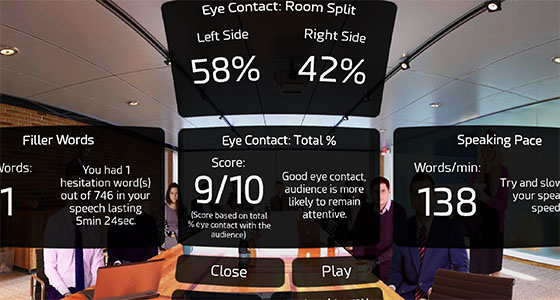
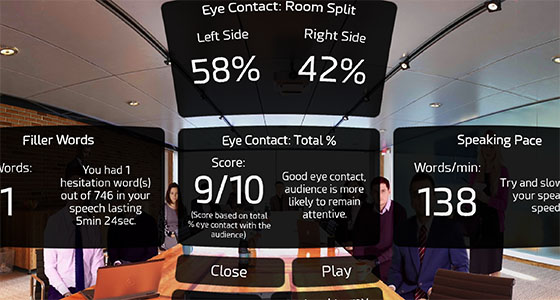
When I work with CEOs, we always do a practice auditorium speech in front of a room of advisors and colleagues. That’s not feasible for everyone, but we can generate a fake audience. It’s definitely worth checking out the VirtualSpeech app – you’re going to need a VR headset, but it’s so worth it. If you’re a bit of a geeky perfectionist like me, the analysis is going to blow your mind.

feature_meeting_analysis

2. Get a good night’s sleep

Even if nobody can see your wobbly legs and there are no handshakes to give away your sweaty palms, a spot of meditation will calm those nerves. There are loads of meditation and guided sleep apps, and it’s such a personal matter, that you’ll just have to browse the App Store yourself, but they’ve come a long way from the whale music. Bedtime stories, hypnotherapy sessions ….

3. Teleprompter like a pro!

This was a recent revelation to me. Before you get too excited, I’m going to stress that I never recommend reading a verbatim script, but if you insist, make sure you write if for speech (check those sentence lengths). Or use it for speaker notes instead of index cards. There are apps which will give you prompts on your phone.  Currently, PromptSmart seems the most established, but there are new ones being released. One final plea if you’re going to use these, watch where your eyes are on the camera!

4. Uhm blaster

OK, this is fun! How often do you think you use “like” or “uhh” … There are game-style apps that will call you out on these. Try the LikeSo app – let me know how addicted you get! It’s like CandyCrush.

I hope that helps, but if you’d like to work with me on your investor presentations, do get in touch.